




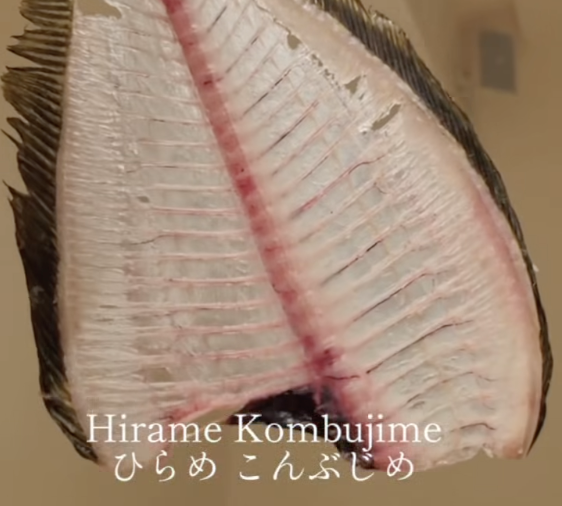
What Is Hirame Kombujime?
Hirame kombujime (昆布締め) is Japanese olive flounder cured between sheets of dried kombu kelp, a technique that firms the flesh and deepens its savoury flavour without any heat. Hirame kombujime tastes cleaner and rounder than raw hirame, with a firm, faintly springy bite, a quiet sweetness, and a long savoury finish carried by glutamate from… Continue reading What Is Hirame Kombujime?
Local Story ● 2026 Jul 27
Hirame kombujime (昆布締め) is Japanese olive flounder cured between sheets of dried kombu kelp, a technique that firms the flesh and deepens its savoury flavour without any heat.
Hirame kombujime tastes cleaner and rounder than raw hirame, with a firm, faintly springy bite, a quiet sweetness, and a long savoury finish carried by glutamate from the kelp.
A hirame kombujime cure usually runs from about four hours to a full day, with short cures keeping the flesh light and translucent and longer cures trading that lightness for softer texture and stronger kombu flavour.
Most fish is at its best the day it leaves the water. Hirame is not most fish. Taken to the board too soon, olive flounder is stubbornly chewy, faintly watery, and inclined to slide off the rice rather than sit on it. So the chef waits. Then the chef does something stranger, wrapping that pale fillet in a dried sea plant that tastes of almost nothing on its own, and waits again. What comes out is hirame kombujime (ヒラメ昆布締め), kelp cured flounder. Yuzu Omakase sets out what the kombu is doing inside that fillet, and why a technique invented to stop fish spoiling outlived the problem it solved.
What Hirame Kombujime Is
Hirame kombujime is a curing method: hirame, the olive flounder, pressed between sheets of dried kombu kelp and rested cold until the kelp has drawn moisture out of the fish and given flavour back in return. The name is literal, since 昆布 is the kelp and 締め means to bind.
Hirame is Paralichthys olivaceus, the large toothed flatfish sold in English as olive flounder or fluke, and a shiromi, one of the lean white fleshed fish that traditionally open a sushi meal. Chefs tell it from karei by where the eyes sit: hidari hirame, migi karei, left for hirame and right for karei when the fish lies white side down.
The kelp met the fish in the Edo period, when kitamaebune ships carried Hokkaido kombu south to Toyama in quantities large enough for daily use. Without refrigeration, cooks packed fresh fish between kombu sheets to keep it, and found it came out firmer and deeper in flavour. Preservation became technique, and kombujime entered Edomae sushi.
How Hirame Kombujime Is Made
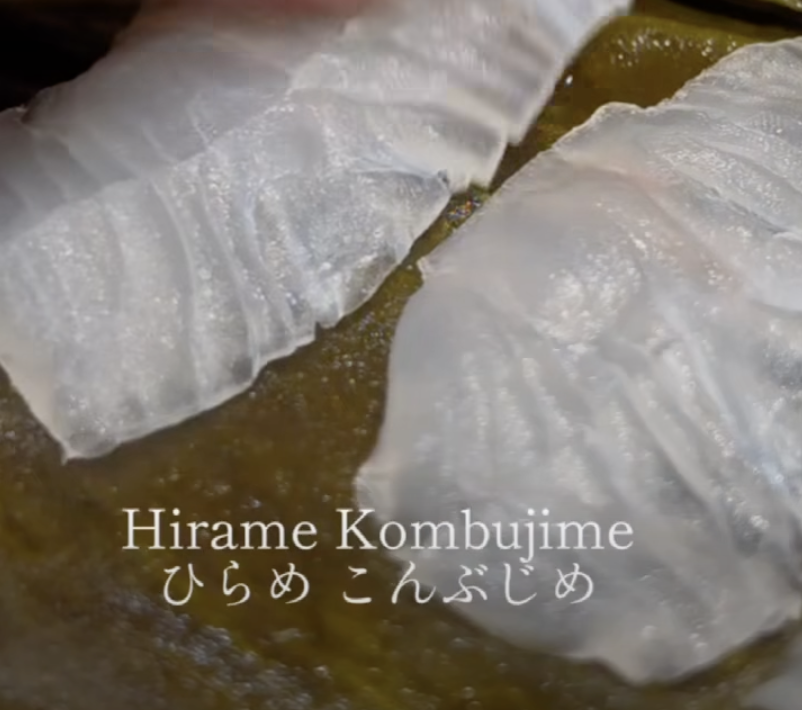
Hirame kombujime is made by salting a trimmed fillet briefly, laying it between two sheets of kombu, weighting it lightly, and holding it cold for anywhere from a few hours to a full day. Two judgements inside that sequence decide the result.
Choosing the kombu
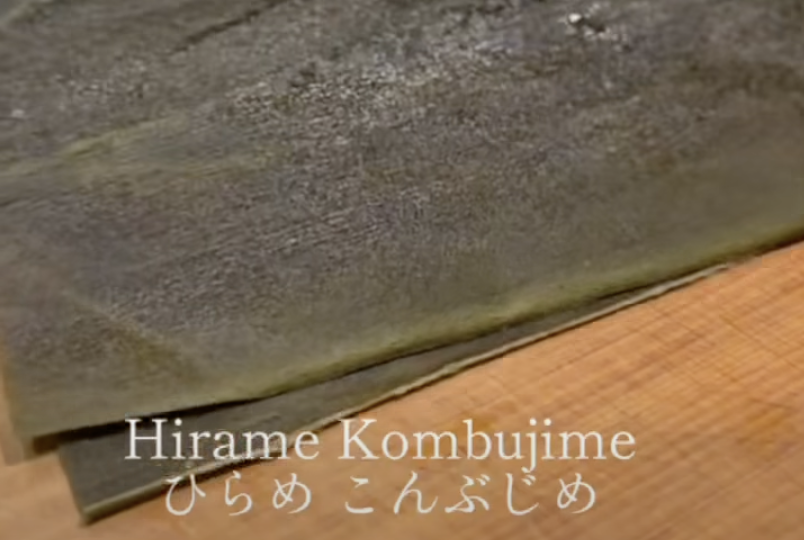
Chefs grade kombu as carefully as they grade rice or vinegar. Ma-kombu (真昆布) from the Tsugaru Strait, the grade often called the king of kombu, gives a clear and elegant sweetness. Rishiri kombu (利尻昆布) from the far north is cleaner and lightly saline, long favoured in Kyoto kaiseki kitchens. Rausu kombu (羅臼昆布) holds the most umami of the common grades but bleeds colour into what it touches. On a fish as pale as hirame, most chefs reach for ma-kombu or rishiri, which add depth without dyeing the flesh or talking over it.
The cure
Time does the work. Dried kombu is thirsty, and a light salting starts water moving out of the fish by osmosis. The kelp takes that water up and sends free glutamate the other way, into the flesh. Less water means the fish tastes more of itself, and the borrowed glutamate stretches the finish. Four to six hours or a single night suits a hirame fillet, thin slices can be ready in six to eight, and twelve hours reads lighter than twenty four. Push further and the fish changes rather than improves, softening until the texture gives way. No chef is watching a clock. They are reading that fillet's thickness, its fat, the season, and where in the course it will land.
Did You Know? A 2025 study of kobujime curing in flounder measured what actually crosses the boundary. Sodium and free glutamate moved into the fish only when kombu was used, while a plain dehydrating sheet pulled out the same water and transferred nothing.
What Hirame Kombujime Tastes Like
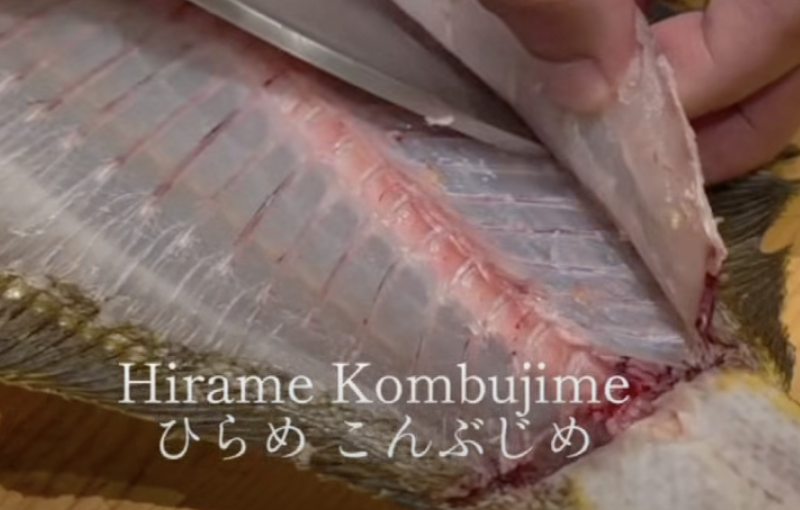
Hirame kombujime tastes like a more focused version of raw hirame rather than a different fish. Raw hirame is deliberately understated: lean, translucent, faintly sweet, with a texture chefs call mocchiri shakkiri, elastic and crisp at once. The cure sharpens all of it. The flesh firms and turns glassier, the wateriness goes, and the sweetness reads more clearly with less liquid diluting it. Behind the sweetness sits the kelp, a faint marine roundness that stays a few seconds after the fish is gone. Hirame runs from late autumn into early spring, and the midwinter fish, kan-birame, carries the most fat of the year, so the same cure lands richer on a winter fillet.
Food Safety and Handling Raw Hirame
Curing hirame in kombu is a flavour and texture technique, not a safety step, and that difference matters. Kelp draws out water and adds umami. It does not kill parasites, and neither does salt or vinegar. Two are relevant to this fish. Anisakis, a nematode found across marine species, is managed by freezing to a documented specification, commonly minus 20 degrees Celsius for seven days. Kudoa septempunctata is more specific: a microscopic parasite of olive flounder that causes a short bout of vomiting and diarrhoea a few hours after eating. Public health guidance in Japan is to freeze flounder flesh at minus 20 degrees Celsius for at least four hours, or heat it to 75 degrees Celsius for five minutes. Reported cases cluster in late summer and are rare from November through May.
What protects a diner is everything around the cure: where the fish came from, whether the freezing specification was met and recorded, whether the cold chain held, and how the fillet was handled once it left the kelp.
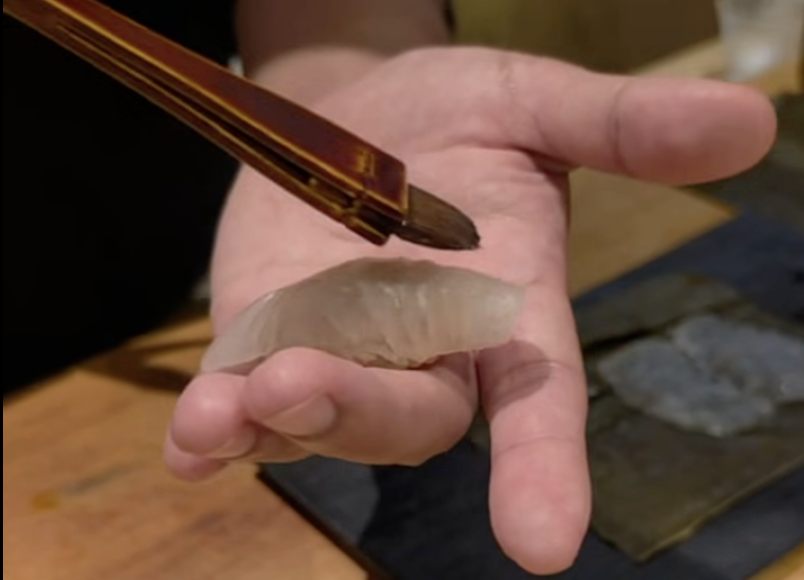
Hirame Kombujime in an Omakase Meal
Hirame kombujime usually arrives early in an omakase course, because shiromi is traditionally where a sushi meal begins and hirame is the classic winter opener. Serving it first is a statement of confidence: there is nothing rich to hide behind. The chef's decisions then stack up inside a few grams of fish: how long to cure that day's fillet, how thickly to cut it so the delicate flavour comes through without turning rubbery, and whether to finish it with sea salt and a squeeze of sudachi rather than soy sauce, which buries a shiromi in one dip.
Did You Know? The most prized cut of a hirame is not the loin but the engawa, the band of muscle that works the fin all day. It is denser and crunchier than the body meat, and a two kilogram fish yields only about fifteen pieces of it.
Frequently Asked Questions
Q: What is hirame kombujime?
A: Hirame kombujime is olive flounder, Paralichthys olivaceus, cured between sheets of dried kombu kelp. The kelp pulls moisture out of the fish and passes glutamate back into it, which firms the texture and deepens the flavour without cooking.
Q: What does hirame kombujime taste like?
A: Hirame kombujime tastes cleaner and rounder than raw hirame: a firm, faintly springy bite, a quiet sweetness that reads more clearly once the water is gone, and a long savoury finish carried by glutamate from the kelp.
Q: How long is hirame cured in kombu?
A: A hirame kombujime cure usually runs from about four hours to a full day. Thin slices can be finished in six to eight hours, whole fillets twelve to twenty four, and longer cures soften the flesh and push the kombu forward.
Q: Is hirame kombujime safe to eat raw?
A: Hirame kombujime can be eaten raw when the fish has been handled to food safety standards. Kelp curing does not kill parasites, so freezing to specification, careful sourcing, and an unbroken cold chain are what manage that risk.
Kombu curing is a lesson in subtraction. Nothing is added to the fish but time, a little salt, and a dried leaf from a cold sea, and yet what comes out tastes more like flounder than what went in. That is the idea worth taking home: the finest work in a sushi kitchen is often not what the chef put on the plate, but what they had the patience to take away.
Reserve a seat at the Yuzu Omakase
Website: https://www.yuzuomakase.com/
Tel: 0638988989
RELATE
-
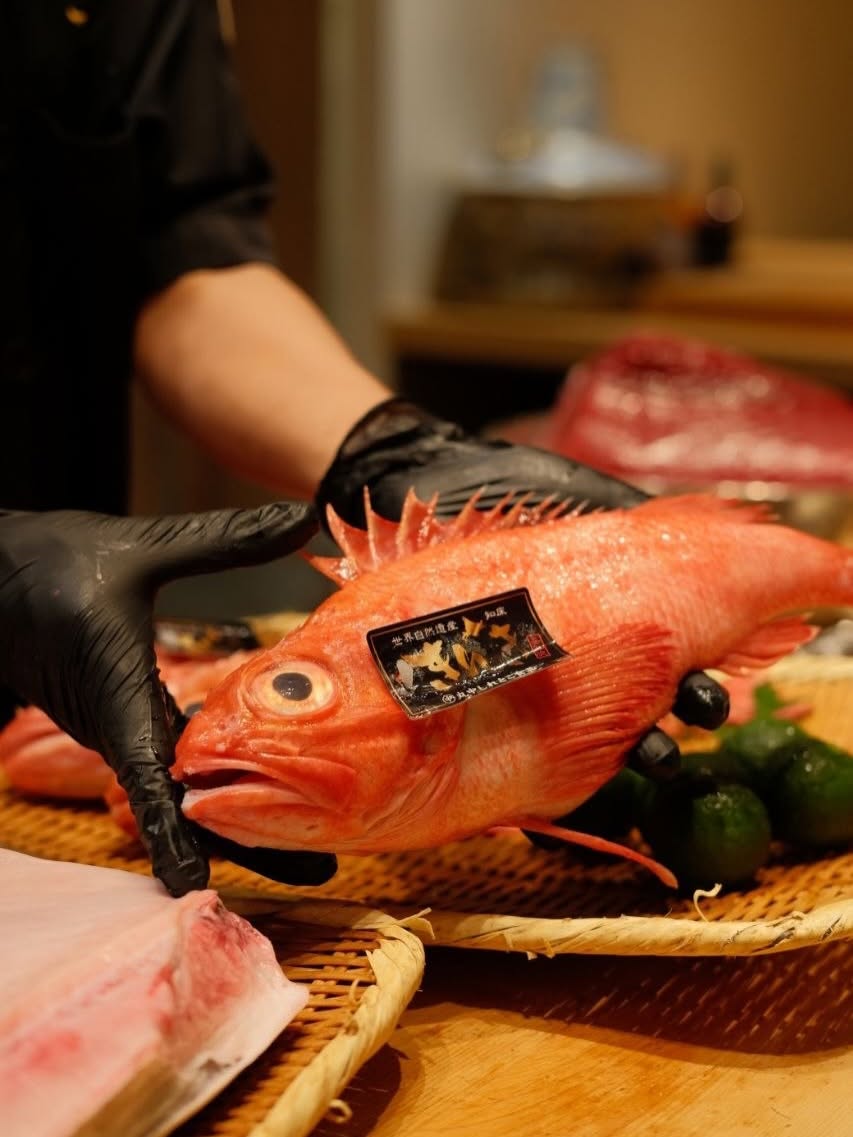
What Is Kinki Fish? Kichiji, the Deep Water
Kinki is the Japanese counter name for Sebastolobus macrochir, a deep water thornyhead from the northwestern Pacific that is classified as a white fish but carries far more fat than a white fish usually does. Kinki, kichiji and menme are three names for one species, used in different regions and different registers, and none of… Continue reading What Is Kinki Fish? Kichiji, the Deep Water
Local Story ● 2026 Aug 30
-
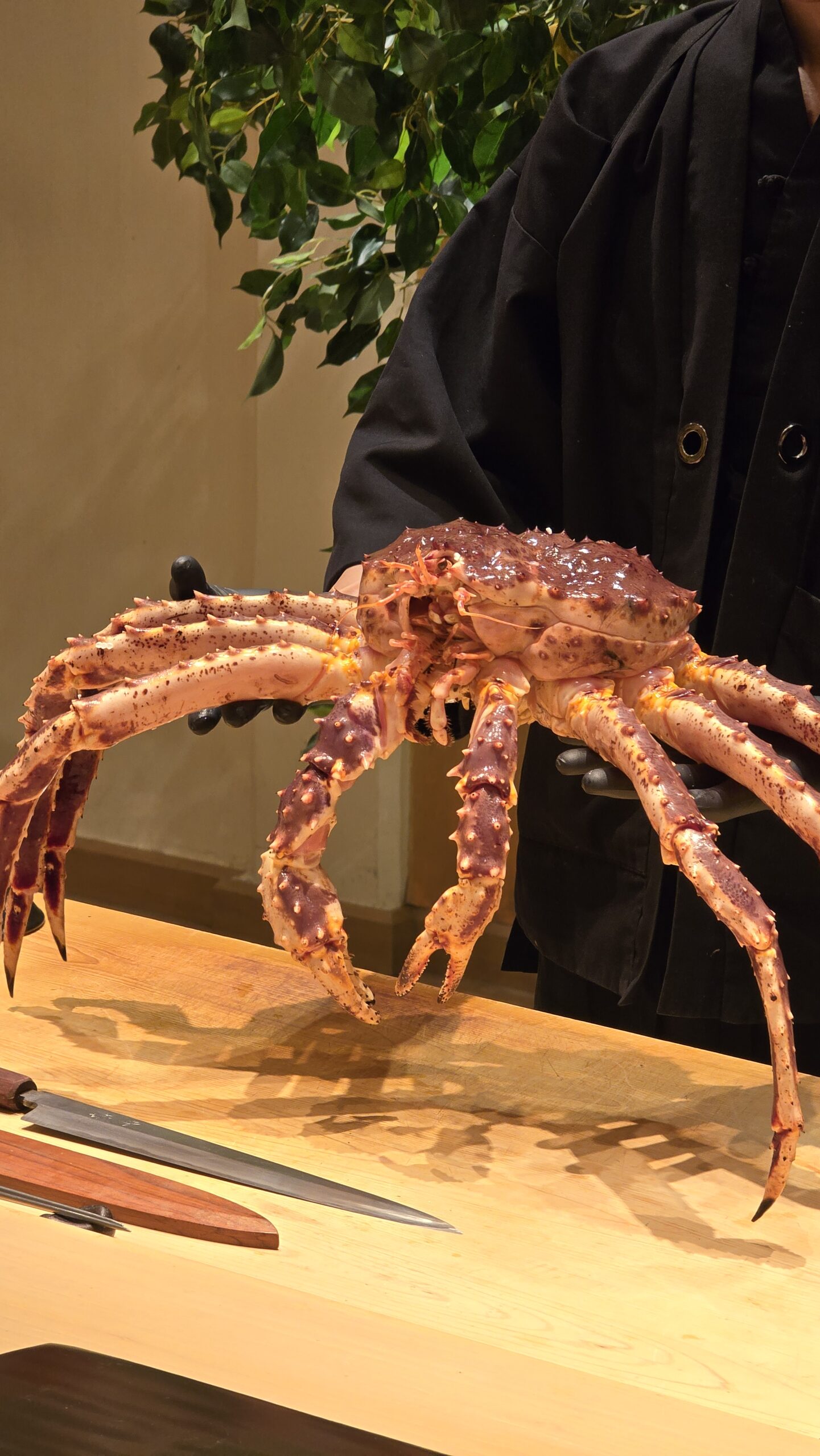
What Is Taraba King Crab? The Hokkaido Giant That Is Not Actually a Crab
Taraba king crab, tarabagani in Japanese, is the red king crab, the largest and most prized of the king crab species found in Japanese waters. Taraba is not a true crab. It belongs to the hermit crab family, and the giveaway is the leg count: true crabs have ten legs, taraba has eight, with two… Continue reading What Is Taraba King Crab? The Hokkaido Giant That Is Not Actually a Crab
Local Story ● 2026 Aug 30
-
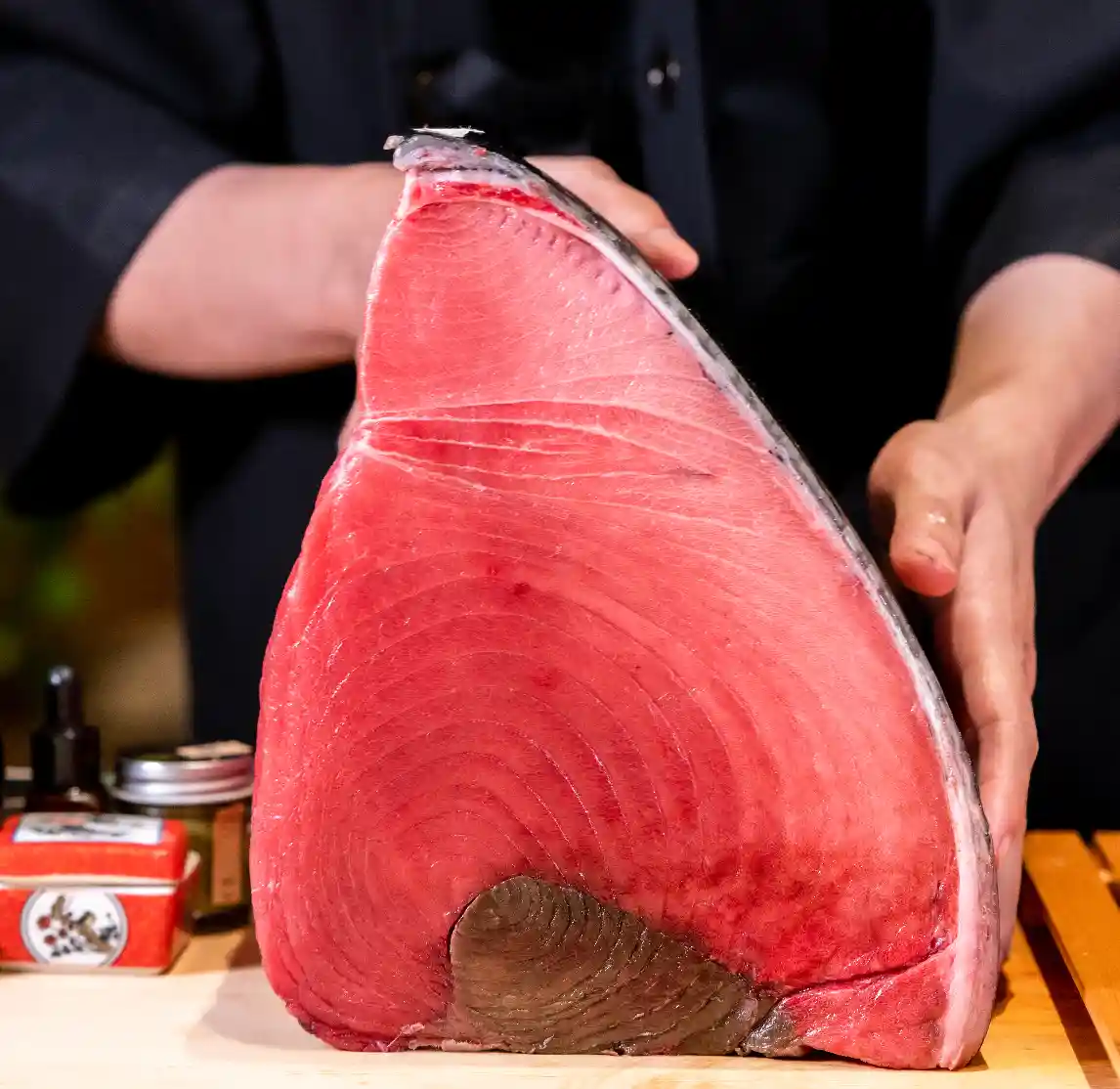
Akami, Chutoro, Otoro: The Three Cuts of Bluefin Tuna
Akami, chutoro, and otoro are the three sushi cuts of bluefin tuna, running from the lean loin along the spine, through the fattier belly and back, to the richest belly section nearest the head. The three cuts of bluefin tuna differ mostly in fat: akami carries barely any, chutoro about 15 to 20 percent, and… Continue reading Akami, Chutoro, Otoro: The Three Cuts of Bluefin Tuna
Local Story ● 2026 Jul 27
-
Why Japanese Akagai
Akagai (赤貝, ark shell or red clam) is one of the few clams whose flesh runs deep red, and it has been a fixture of Tokyo sushi counters since the nineteenth century. The color comes from a hemoglobin-like pigment in its blood, the texture is firm and crisp, and the aroma is the strongest argument… Continue reading Why Japanese Akagai
Local Story ● 2026 Jun 30

